Unlocking Earth's Secrets: 1.5 Million-Year-Old Ice to be Melted for Climate Insights
2025-07-18
Author: William
A Glacial Treasure Trove Awaits
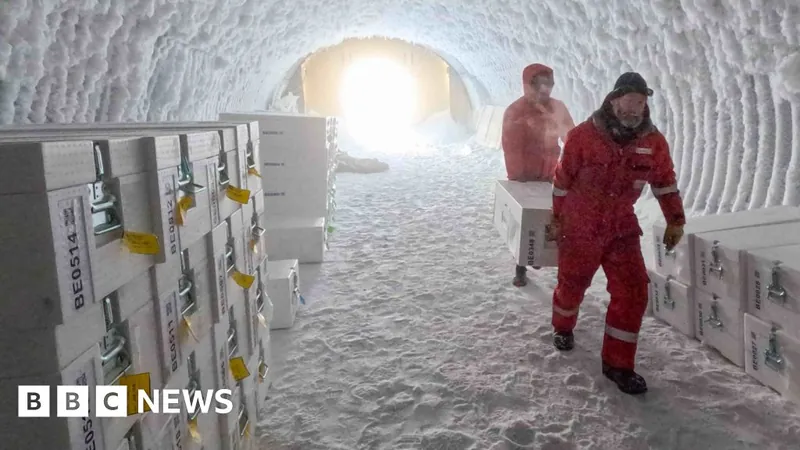
Deep within the icy recesses of Antarctica lies a cylindrical treasure—an ice core thought to be a staggering 1.5 million years old. This ancient ice has made its way to the UK, where scientists are set to melt it down to reveal crucial secrets about Earth's climate.
The Ice that Holds History
This remarkable piece of ice, the oldest on our planet, was carefully extracted from beneath the Antarctic ice sheet. Researchers believe that encased within it are thousands of years of climate records that could fundamentally change our understanding of climate change.
Step Inside the Frigid Lab
At the British Antarctic Survey in Cambridge, an ominous -23°C freezer hosts the precious ice core. Inside, red warning lights flash, indicating a highly controlled environment, and researchers don protective gear, ready to spend only a short time in the extreme cold.
The Melting Process Begins
For the next seven weeks, experts will melt this groundbreaking ice, releasing ancient dust, volcanic ash, and even tiny marine algae. These remnants hold the key to deciphering past wind patterns, temperatures, and sea levels, providing a window into Earth's climatic history over a million years ago.
Global Collaboration for Climate Research
The efforts to extract these ice cores required a multinational team and significant investment. Ice sections were transported across challenging terrains, carefully packed to preserve their integrity on a long journey to Cambridge.
Connecting Today with the Past
Researchers are particularly interested in a period more than 800,000 years ago when carbon dioxide levels may have been similar to or even higher than today's. This research is crucial in understanding future climate scenarios, especially given that current climate change is predominantly driven by human activity.
Decoding Climate Mysteries
Scientists aim to unravel the mysterious changes during the Mid-Pleistocene Transition, examining how glacial cycles evolved over the ages. Utilizing advanced instruments, they will identify a plethora of chemical isotopes to unearth vital data about wind patterns, rainfall, and other environmental indicators from our planet’s ancient past.
What Lies Ahead?
As scientists embark on this unprecedented journey into climate history, they hold the hope that the secrets unlocked by this ancient ice will illuminate our path forward in a warming world. With every drop of water released, the accumulated wisdom of Earth’s climate may provide the guidance we desperately need for the challenges ahead.








 Brasil (PT)
 Canada (EN)
 Chile (ES)
 Česko (CS)
 대한민국 (KO)
 España (ES)
 France (FR)
 Hong Kong (EN)
 Italia (IT)
 日本 (JA)
 Magyarország (HU)
 Norge (NO)
 Polska (PL)
 Schweiz (DE)
 Singapore (EN)
 Sverige (SV)
 Suomi (FI)
 Türkiye (TR)
 الإمارات العربية المتحدة (AR)