Sony's RX1R III: A Photographic Marvel or a Stubborn Misstep?
2025-07-17
Author: Emma
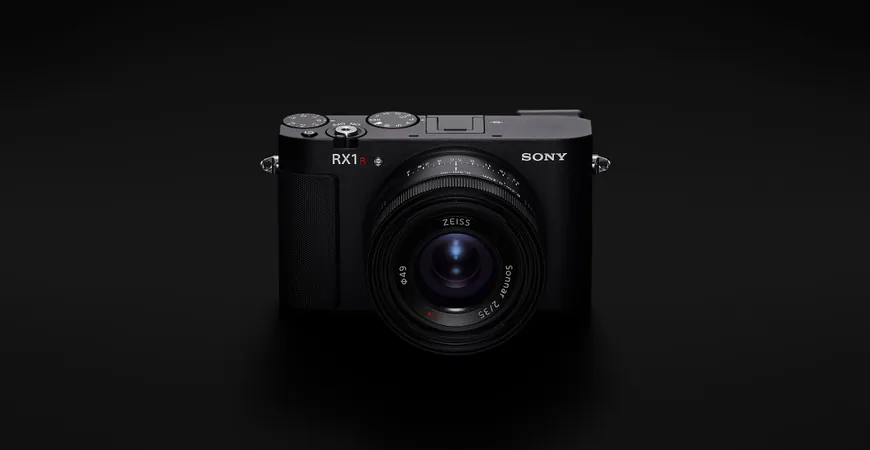
The highly anticipated Sony RX1R III camera has finally arrived, and it’s turning heads for all the right and wrong reasons. Priced at a staggering $5,100, this compact full-frame beauty has been long-awaited by hardcore photography enthusiasts who crave an upgrade from the beloved RX1.
But here’s the kicker: Sony has ditched the tiltable screen that its predecessor offered. This fixed rear LCD screen is a significant letdown for street photographers and those who rely on unique angles for their shots, making it harder to capture candid moments from the hip or overhead.
Despite this oversight, Sony has not skimped on upgrades. The RX1R III boasts a high-resolution full-frame sensor borrowed from the A7R V, a state-of-the-art autofocus system, a battery that lasts longer, and a proper electronic viewfinder—no more pop-up nonsense! The designers even reimagined the overall aesthetics, integrating top dials and a hot shoe seamlessly into the camera body.
However, in their quest to maintain compactness, Sony merely increased the RX1R III’s height by 2.5mm and depth by 15.5mm, largely due to the protruding Zeiss 35mm f/2 lens. Many photographers wonder why a few extra millimeters in thickness or width couldn’t accommodate a tilting screen. And let's not forget, with such a slim profile, there's still no lens or sensor-based image stabilization—something that has consistently eluded RX1 models.
Sony's obsession with keeping their cameras small has been a bone of contention for some time. Their Alpha mirrorless line has set standards with innovations like eye-detect autofocus. Yet, while these cameras have become technological triumphs, ditching comfort for compactness has often left users feeling frustrated. If comfort were paramount, many agree they might lean toward brands like Nikon or Canon for long shooting days.
Improvements in ergonomics are evident in the A9 III and A1 II, boasting deeper grips that enhance usability—but bad habits linger. Long sessions can still result in that uncomfortable 'Sony knuckle' pain, a reminder that form sometimes trumps function.
Sony aims to pack a lot into a small device with the RX1, challenging even the popular Fujifilm X100VI. But let's be real: these cameras aren't exactly pocket-sized. They still demand to be slung over a shoulder or stored in a bag, much like the larger Leica Q2—which, by the way, is noted for its superior ergonomics.
Despite the Leica-level pricing, Sony remains obstinate about size, overlooking a fundamental feature its users have come to expect. Leica, on the other hand, made a slight design compromise with the Q3 by adding a basic tilt screen after user demand.
For a while, I considered whether the RX1R III could tempt me to switch from my Leica Q2, especially given Sony’s superior autofocus for everyday chaos, like capturing my rambunctious toddler. But the absence of a tilting screen has left me hesitant. I never imagined such an integral convenience would be sacrificed.
While Sony's cameras are celebrated for their extensive features, the RX1R III may unfortunately miss the mark, especially at its eye-watering price.








 Brasil (PT)
 Canada (EN)
 Chile (ES)
 Česko (CS)
 대한민국 (KO)
 España (ES)
 France (FR)
 Hong Kong (EN)
 Italia (IT)
 日本 (JA)
 Magyarország (HU)
 Norge (NO)
 Polska (PL)
 Schweiz (DE)
 Singapore (EN)
 Sverige (SV)
 Suomi (FI)
 Türkiye (TR)
 الإمارات العربية المتحدة (AR)